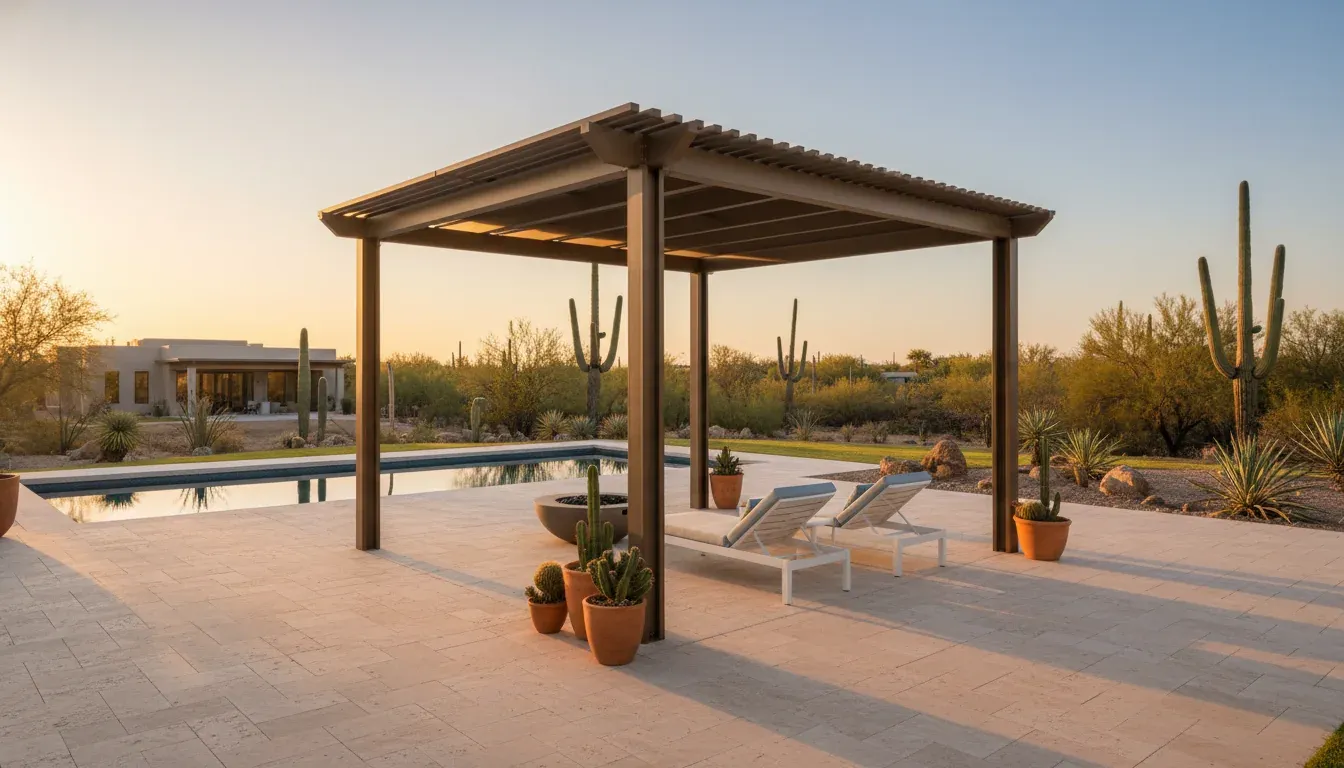
Pergola types · 05 of 06
Attached Pergolas
in Tucson.
Roof-tied or ledger-mounted. The cleanest continuity between house and patio, and a different build than freestanding.
An attached pergola is the most common configuration in greater Tucson, and done right it reads as architecture rather than an addition. Two things to know before you get a quote. Anything structurally tied into the house requires a Pima County permit regardless of how small it is, and every post still needs its own footing dug, poured, and cured as a separate phase before the pergola goes up. That makes an attached build a different job from a freestanding one on the same patio, and it is why the quote comes after a site visit rather than over the phone.
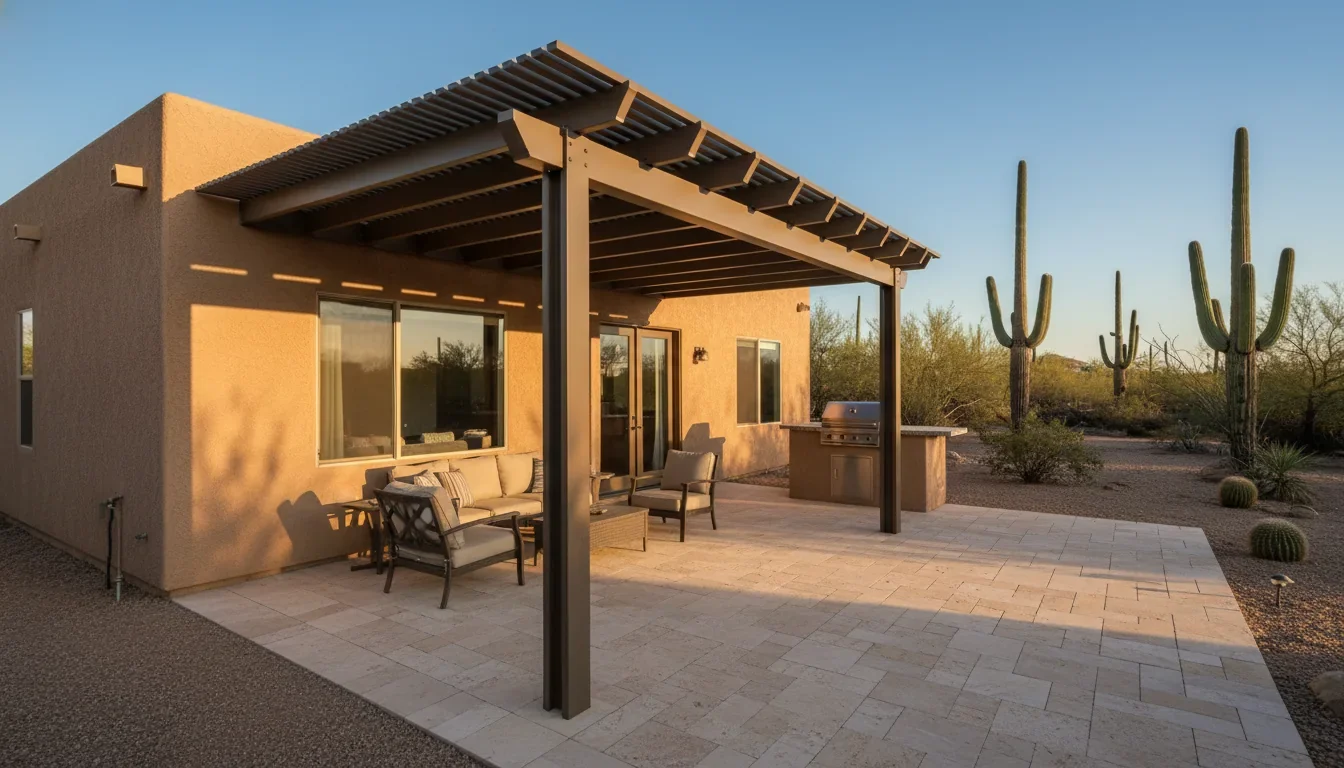
The pergola that becomes part of the house
None of these are visible
from the patio.
Where the ledger sits relative to your fascia. Whether the roof line continues your existing slope or breaks against it. Whether the post centers align with your interior sightlines through the windows. Whether the wind load is transferred into your framing or into your stucco.
All of them are what separates a 25-year attached pergola from a 7-year one.
Every project here starts with a licensed Tucson pro who treats the connection to the house as the most important part of the build, because in our experience, it is.
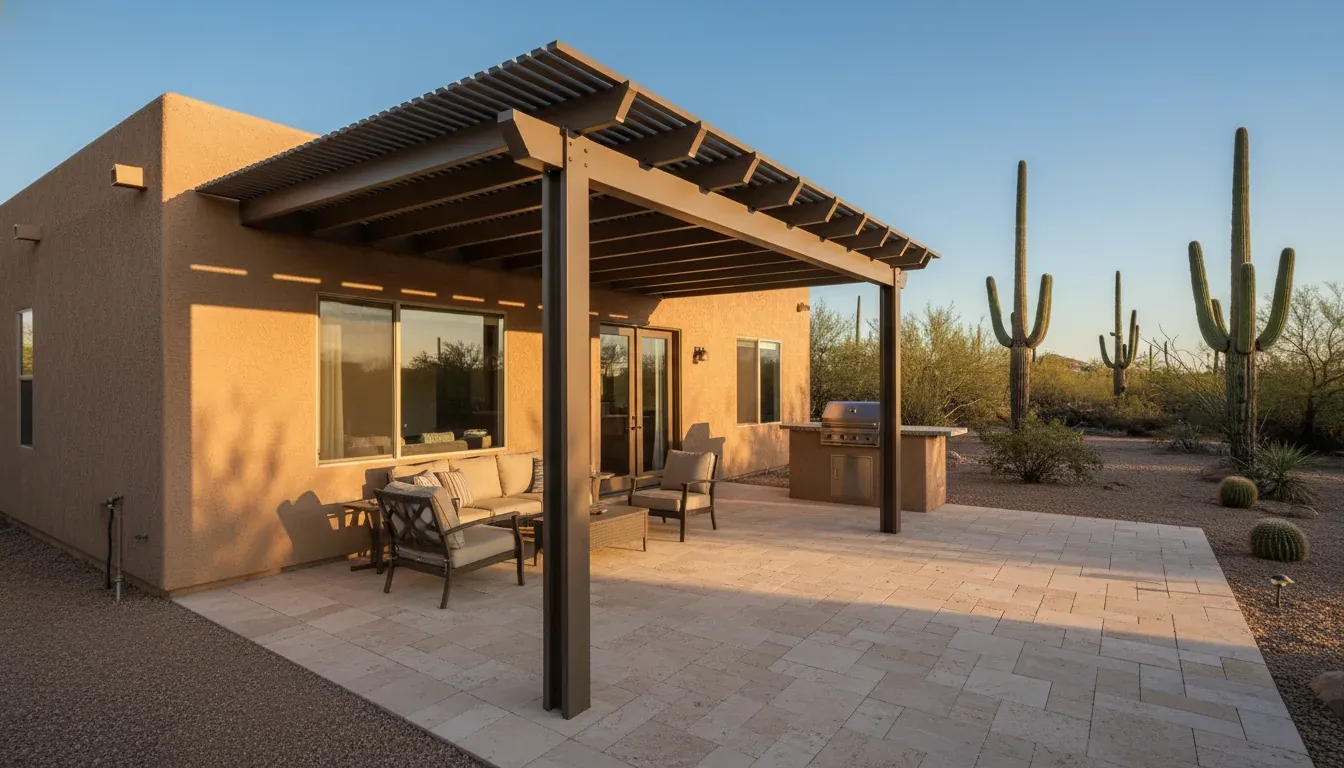
Approach one
Ledger-mounted.
The standard, 75% of builds.
A horizontal beam, the ledger, is through-bolted into the structural framing of your home, typically into the wall's top plate or into a header that distributes load across the studs. The pergola roof framing then bears on the ledger.
This is the right approach for roughly 75% of Tucson attached pergolas. It's structurally clean, it pulls load directly into the home's framing, and it allows the pergola's roof plane to sit anywhere on the wall: above a window, below a soffit, or aligned to the existing eave.
The most common failure mode in poorly-installed attached pergolas is exactly this, a ledger attached without confirming what's behind the wall, or without proper flashing, leading to water intrusion or structural failure years later.
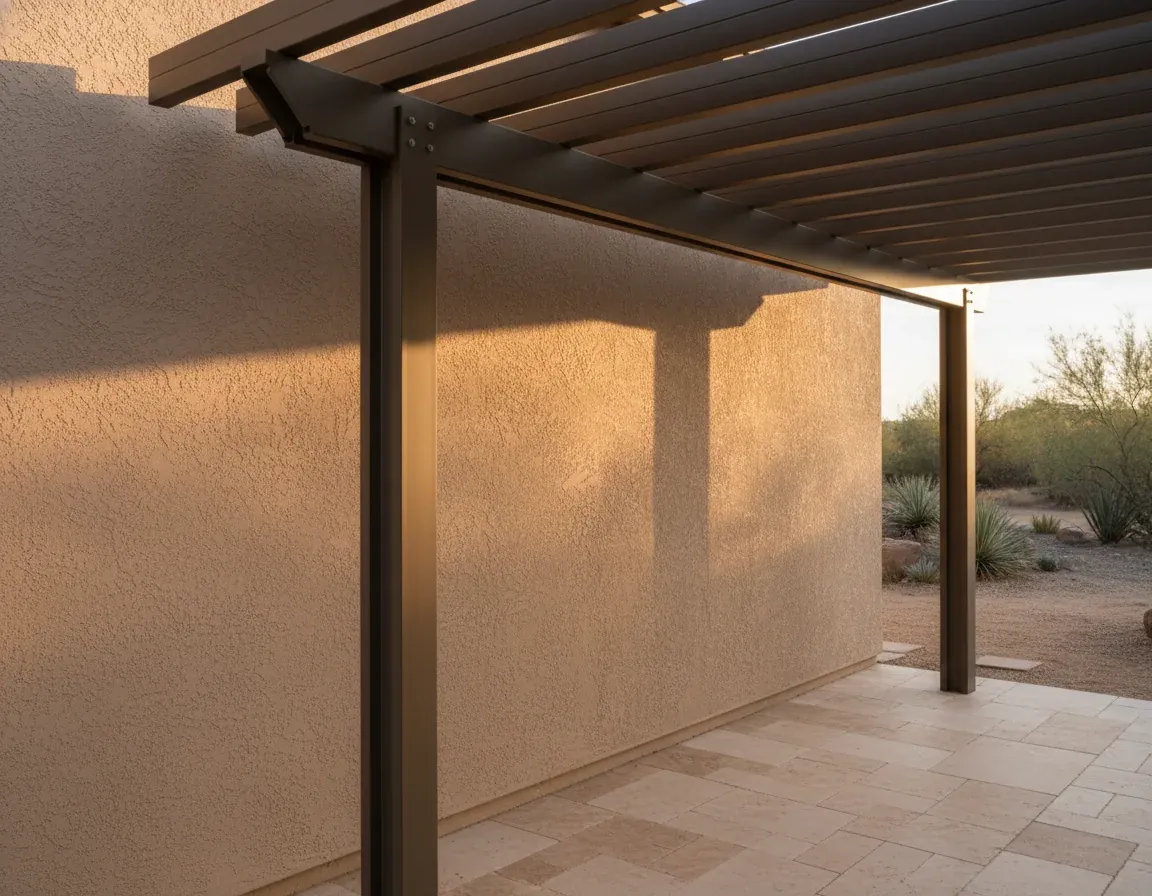
Approach two
Roof-tied.
The architectural one, 25% of builds.
Instead of attaching to the wall, the pergola's roof framing is tied directly into your home's roof structure, typically into the rafters or trusses, with the pergola roof becoming an extension of your existing roof line.
This is the right approach when the existing roofline is a low slope the pergola will continue, when the patio is below an existing eave that can be extended outward, when the architectural language requires unbroken roof continuity, or for solid-roof pergolas where water management through the existing roof is preferable to a new gutter system.
For Spanish revival homes with tile roofs, contemporary homes with parapets, and pueblo-style homes with viga-extended eaves, roof-tied is often the only correct choice.
Standard inclusions
What ships on a licensed
Tucson attached build.
-
Stamped structural engineering
Licensed Arizona engineer, addressing pergola and load transfer
-
Pre-installation framing inspection
Wall opened and inspected before drilling, documented
-
Self-adhered flashing membrane
Lapped over the WRB to prevent moisture into the wall cavity
-
Structural fasteners only
1/2" lag bolts or through-bolts. Never screws into stucco
-
Engineered footings
Outboard posts sized for soil and wind load
-
Sealed flashing transitions
At every roof or fascia interface, appropriate materials
-
Wind-load calculations
Specific to your microclimate, not generic Tucson averages
-
Material-agnostic
Aluminum, wood, steel, or motorized louvered, your choice
The material itself, aluminum, wood, or steel, is a separate decision. The connection engineering standards do not flex regardless of which material you choose.
What it costs in Tucson
What actually drives
an attached quote.
-
The permit is not optional
Anything structurally tied into the house requires a Pima County permit regardless of how small it is. That is a fixed cost before a single post is set.
-
Footings come first
Each footing is dug, poured, and cured as its own phase ahead of the install. Caliche depth decides how hard that dig is.
-
How the house is built
The wall type, roofline, fascia condition, and where the load can actually be carried all change the attachment detail.
-
Roof system and add-ons
A fixed roof, an operable louvered roof, motorization, lighting, and heat are four different builds.
Attached projects are quoted after a site visit, and the visit matters more here than anywhere else. An attached structure carries permitting and footing work that a freestanding pergola in the middle of the yard does not, so two builds that look identical in a photo can sit a long way apart on paper.
Why attached works in Tucson
The case for attached
over freestanding.
Structural, architectural, and about how the patio actually gets used. Five reasons that come up most often during the site walk.
-
Continuous shade outward
From the house wall to the patio edge
Tucson patios get used most in the morning and evening, before the sun is overhead, when the shadow from the house itself is doing most of the shade work. An attached pergola extends that shade outward without a gap between the house wall and the pergola roof. A freestanding pergola, however close it sits to the house, will always have a slot of direct sun between the building wall and the pergola edge.
-
Architectural integration
Spanish revival, Pueblo, Territorial
Tucson's dominant residential architectural styles all evolved around the concept of the patio attached to the house. The traditional Sonoran ramada is, structurally, an attached pergola. Building attached is consistent with the architectural language of Tucson. Building freestanding sometimes isn't.
-
HOA preference
Consolidated visual mass
A small number of Foothills and Oro Valley sub-associations specifically prefer attached pergolas over freestanding because the visual mass is consolidated against the home rather than dispersed across the yard. We'll know during the site walk whether your specific HOA has this preference, and guide the design accordingly.
-
Better wind performance
Paradoxically
A properly engineered attached pergola actually has better wind performance than a comparable freestanding pergola, because the connection to the house provides additional lateral bracing. The structural engineer can credit the house's framing as part of the pergola's wind resistance, which often allows for thinner profiles and clearer spans.
-
Drainage continuity
Tied into existing gutters
Tucson averages only 12 inches of rain per year, but most of it falls in monsoon-season cloudbursts. Attached pergolas with solid roofs can tie directly into your home's existing gutter system rather than requiring new downspouts, ground-level drainage, and grading work.
If your patio is directly against the house and your roofline accepts the connection, attached is almost always the better answer.
HOA, permits, Pima County
The engineering stamp
is non-negotiable.
Attached pergolas in Pima County require a residential building permit and a stamped structural engineering set, with specific calculations addressing the load transferred into the existing home framing. This engineering requirement is non-negotiable and applies regardless of size. Even a 10'×10' attached pergola in Pima County requires the stamp.
A licensed installer handles every page of permitting. The pre-installation framing inspection, a standard on every project here even where the county doesn't require it, is conducted before the structural engineering is finalized, so the engineering reflects what's actually behind your wall.
HOA submissions in the Foothills and Oro Valley
Typically include a site plan, elevation drawings showing the pergola in context, material and finish samples for stained wood or non-standard powder-coat finishes, the structural engineering set with the engineer's stamp visible, and photos of the attachment surface showing existing conditions.
Submissions typically clear within the standard ARC review window when the material, finish, and connection details are chosen to fit the existing architecture. A licensed installer handles the submission process end-to-end.
How the project moves
From wall inspection
to first connection.
-
Reach out
Day oneA quick call with a licensed Tucson pergola pro covers your home, your roofline, the look you have in mind, and a rough budget. You get straight answers to your first questions before anyone visits.
-
Schedule a consultation
Week 1A licensed installer visits, measures the wall heights and roofline conditions, inspects the existing fascia and eave, and determines whether ledger-mounted or roof-tied is the right approach. The attached design is fit to your home's architecture in person.
-
Review design options
Weeks 2–3Two design directions come back, with a licensed structural engineer engaged for the connection calculations and a line-itemed quote. For roof-tied designs, the original architect or builder is consulted where available to verify rafter spacing and load paths.
-
Proceed with installation
Weeks 3–8Pima County permits and any HOA submission are handled first. Before structural work begins, the installer opens a small inspection point on the wall to confirm the framing behind the planned attachment matches the engineering assumptions. Footing for the outboard posts is poured (2 to 3 days, plus 7-day cure). Ledger installation, flashing, and framing typically take 3 to 5 days on site.
-
Final walkthrough & inspection
Final dayYour installer demonstrates the structure, shows you the flashing and weather sealing detail (you should see it once before it's hidden permanently behind cladding), and hands you the engineering set, warranty package, and care binder. A check-in follows at 30 days and 6 months.
Every step has a name and a date. You'll never have to ask where we are.
Attached pergola reviews
Tucson homeowners on their
attached pergolas.
Ledger-mounted to the fascia so it reads as part of the house, not a bolt-on. The installer on our project flashed the connection properly and got the engineering stamp. Seamless line from the living room out to the patio.
We wanted the patio to feel like an extension of the kitchen. Attached pergola, roof-tied, and the pro handled the Pima County permit and the structural tie-in. Exactly the indoor-outdoor flow we pictured.
One point of contact who understood our roofline and drainage. The design was right the first time and the attachment detail has stayed watertight through two monsoons.
Attached pergola installation across greater Tucson
Attached pergolas & patio covers across Southern Arizona.
Licensed installation for ledger-mounted and roof-tied attached pergolas and patio covers, properly flashed and engineered, throughout the greater Tucson metro and Pima County.
- Tucson
- Catalina Foothills
- Oro Valley
- Marana
- Vail
- Sahuarita
- Green Valley
- Sabino Vista
- Saguaro Ridge
- Dove Mountain
- Pima County
- And nearby areas
Attached pergola questions
What every Tucson homeowner
asks about attaching.
-
01. Will an attached pergola damage my home?
Not if it's installed correctly. The connection should be made into structural framing, properly flashed, and engineered for the load. Damage to homes from attached pergolas almost always traces to one of three failures: connection into stucco rather than structural framing, missing or inadequate flashing behind the ledger, or under-engineered fasteners. Every one of these is preventable when the install is done correctly. -
02. Can I attach a pergola to a stucco wall?
You can attach a pergola through a stucco wall, into the structural framing behind it. You cannot attach a pergola to a stucco wall, meaning, into the stucco itself. A properly installed attached pergola uses through-bolts or structural lag bolts driven into wood framing, with the stucco serving only as the exterior finish that the bolts pass through. The flashing seals the penetration. -
03. What if my house has a tile roof?
Tile roofs require a roof-tied approach, with specific tile-removal and tile-replacement protocols around the connection points. A tile-roof project is handled by a licensed installer with specific tile-handling experience on Spanish revival homes. The connection itself is made into the rafters beneath the tile, not into the tile surface. -
04. Attached vs freestanding, how do I decide?
Attached if your patio is directly against the house, if your home's architecture would benefit from visual continuity, if your HOA prefers consolidated structures, or if you want continuous shade from the house outward. Freestanding if your patio sits away from the house, if you want flexibility in where the pergola goes, or if your home's roofline makes attachment structurally difficult. The site walk usually makes the answer obvious within 20 minutes. -
05. Will my home insurance cover an attached pergola?
Generally yes, when it's permitted and engineered. Most homeowner policies in Arizona cover permitted attached structures as part of the dwelling coverage. Unpermitted or improperly engineered structures are routinely denied coverage in claims situations. The Pima County permit and the structural engineering stamp are not bureaucratic boxes, they're what makes the structure insurable. -
06. How does an attached pergola affect my home's resale value?
A permitted, professionally installed attached pergola in Tucson generally adds resale value, with the strongest returns on properties where the pergola creates a defined outdoor living space that wasn't previously usable. Returns are weaker on over-built pergolas where the rest of the yard doesn't match the investment level. Your real estate agent will be a better source for a specific estimate than we will.
Have a question we didn't cover? Ask it in the form below. We answer most within the hour.
Local attached pergola installation you can count on
Want your patio to feel like an extension of the house?
Ledger-mounted or roof-tied, properly flashed and engineered for the connection. Your project starts with a licensed Tucson installer who fits the build to your roofline, your HOA, and your timeline.
Or call (520) 639-9422 · Mon–Fri 8a–5p
Tell us about your lot, get a quote from a licensed Tucson attached pergola pro.
Service area
- Tucson
- Catalina Foothills
- Oro Valley
- Marana
- Vail
- Sahuarita
- Green Valley